
Enhanced TDS
Identification & Functionality
- Chemical Family
- RTU Product Type
- Technologies
- Product Families
Features & Benefits
- Labeling Claims
- Ready-to-Use Product Features
- Key Properties
- Good mechanical and electrical properties.
- High thermal shock resistance.
Applications & Uses
- Composites Processing Methods
- Cure Method
- Product End Uses
- Markets
- Applications
- Processing Methods
- Conventional gravity casting process under vacuum.
- Processing Information
General instructions for preparing liquid resin systems
- Long pot life is desirable in the processing of any casting resin system. Mix all of the components together very thoroughly at room temperature or slightly above and under vacuum. Intensive wetting of the filler is extremely important. Proper mixing will result in:
- better flow properties and reduced tendency to shrinkage
- lower internal stresses and therefore improved mechanical properties on object
- improved partial diskharge behavior in high voltage applications.
- For the mixing of medium- to high viscous casting resin systems and for mixing at lower temperatures, we recommend special degassing mixers that may produce additional selfheating of 10-15 K as a result of friction.
- For low viscous casting resin sys-tems, conventional mixers are usually sufficient. In larger plants, the individual components (resin, hardener) are mixed with the respective quantities of fillers and additives under vacuum. Metering pumps then feed these premixes to the final mixer or a continuous mixer. The individual premixes can be stored at elevated temperature (about 60°C) for up to about 1 week, de-pending on formulation. Intermittent agitation during storage is advisable to prevent filler sedimentation.
- Mixing time can vary from 0.5 to 3 hours, depending on mixing temperature, quantity, mixing equipment and the particular application. The required vacuum is 0.5 to 8 mbar. The vapor pressure of the individual components should be taken into account. In the case of dielectrically highly stressed parts, we recommend checking the quality consistency and predrying of the filler. Their moisture content should be <0.2%.
Specific Instructions
The effective pot-life of the mix is about 1 - 2 days at temperatures below 25°C. Conventional batch mixers should be cleaned once a week or at the end of work. For longer interruptions of work, the pipes of the mixing and metering installllations have to be cooled and cleaned with the resin component to prevent sedimentation and/or undesired viscosity increase. Interruptions over a week-end (approx. 48h) without cleaning are possible if the pipes are cooled at temperatures below 18°C. Viscosity increase and gel time at various temperatures.
Mold temperature
APG process: 70 - 100°C
Demolding times (depending on mold temperature and casting volume)
Conventional vacuum casting: 5 - 10 h-
PostCure conditions
Conventional vacuum casting: (10 – 12) h at 120 - 130°C or 4 h 140 °C
Total curing cycle (typically):
8 h (80 – 85) °C + 2 h 100 °C * demolding* + 12 h (120 – 130) °C or
8 h (80 – 85) °C + 2 h 100 °C * demolding* + 4 h 140 °C- To determine whether crosslinking has been carried to completion and the final properties are optimal, it is necessary to carry out relevant measurements on the actual object or to measure the glass transition temperature. Different geling and cure cycles in the manufacturing process could lead to a different crosslinking and glass transition temperature respectively.
Properties
- Physical Form
Regulatory & Compliance
- Certifications & Compliance
Technical Details & Test Data
- Cured Properties
Processing Viscosities
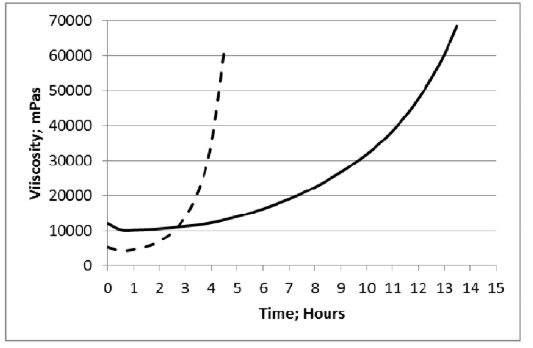
Fig.4.1: Viscosity increase at 60 and 80°C (measurements with Rheomat 115)
(Shear velocity D = 10 s-1)Gelation-/Cure Times
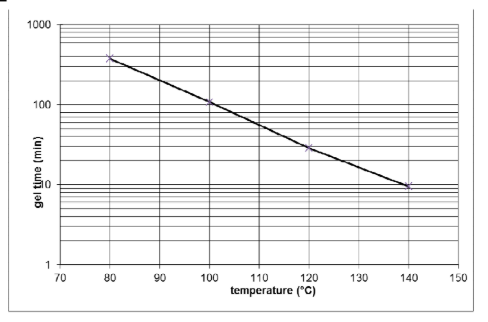
Fig.4.2: Gel time as a function of temperature
(measured with Gelnorm Instrument, ISO 9396)Mechanical and Physical Properties
Key
Value
Unit
Test Method
Test Condition
Tensile strength 68 - 78 MPa ISO 527 at 23°C Elongation at break 1.35 - 1.45 % ISO 527 at 23°C E modulus from tensile test 10,000 - 11,000 MPa ISO 527 at 23°C Flexural strength 120 - 130 MPa ISO 178 at 23°C Surface strain 1.35 - 1.45 % ISO 178 at 23°C E modulus from flexural test 11,000 - 12,000 MPa ISO 178 at 23°C Double Torsion Test: Critical stress intensity factor (K1C) 3.10 - 3.70 MPa·m½ CG 216-0/89 at 23°C Double Torsion Test: Specific energy at break (G1C) 800 - 900 J/m² CG 216-0/89 at 23°C Thermal conductivity similar to 1.02 - 1.04 W/m·K ISO 8894-1 at 23°C Coefficient of linear thermal expansion 31 - 34·10⁻⁶ K⁻¹ ISO 11359-2 Mean value for temperature range: 20 - 40°C
Glass transition temperature (DSC) 50 - 60 °C ISO 11357-2 at 23°C Water absorption (specimen: 50x50x4 mm) 0.15 - 0.22 % by wt. ISO 62 10 days at 23°C Water absorption (specimen: 50x50x4 mm) 0.22 - 0.30 % by wt. ISO 62 60 min at 100°C Density (Filler load: 66% by wt.) 1.83 - 1.86 g/cm³ ISO 1183 at 23°C Electrical Properties
Key
Value
Unit
Test Method
Test Condition
Breakdown strength 22 - 28 kV/mm IEC 60243-1 at 23°C Cured for 6h at 130°C.
Tracking resistance with test solution A >600 - <1 CTI IEC 60112 at 23°C Cured for 6h at 130°C.
Tracking resistance with test solution B >600M - <1 CTI IEC 60112 at 23°C Cured for 6h at 130°C.
HV arc resistance 180 - 190 s IEC 61621 at 23°C Cured for 6h at 130°C.
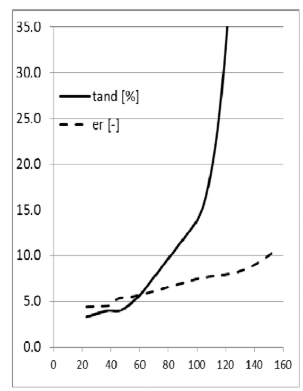
Fig.6.1: Loss factor (tan δ) and Dielectric constant (εr) as a function of temperature
(measurement frequency: 50 Hz, IEC 60250)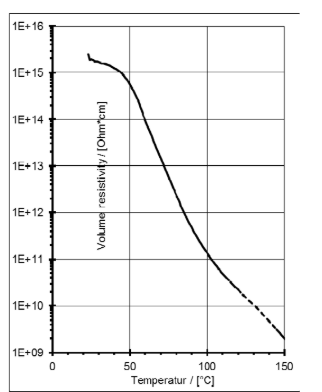
Fig.6.2: Volume resistivity (ρ) as a function of temperature
(measurement voltage: 1000 V, IEC 60093)
Storage & Handling
- Storage Conditions
Store the components in a dry place according to the storage conditions stated on the label in tightly sealed original containers. Under these conditions, the shelf life will correspond to the expiry date stated on the label. After this date, the product may be processed only after reanalysis. Partly emptied containers should be tightly closed immediately after use.
Other
- Application Information
Value Units Test Method / Conditions Mix Ratio 3.9 %(W) %(W) Filler : Resin Mix Ratio 1.0 %(W) %(W) Hardener : Resin